

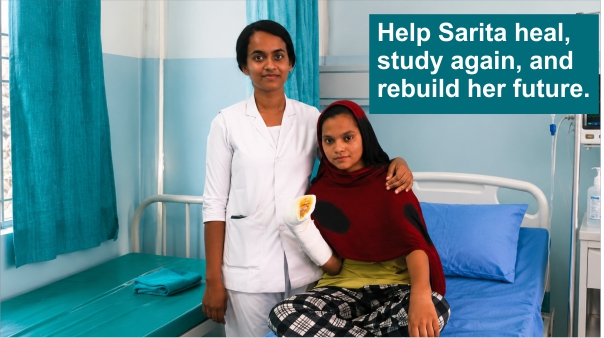
Sarita comes from Araria district in Bihar, a remote region bordering Nepal. She belongs to a humble farming family. Her father works hard to support the family through farming, while her mother cares for the household. Despite the challenges of growing up in a large family with limited means, Sarita was a determined student who dreamed of becoming a teacher.
When Sarita was only 12 years old, she woke up one morning to find that one of her hands had become numb. Alarmed by the sudden change, she informed her father, who took her to a local dispensary. Medicines were prescribed, but her condition did not improve. Over the following months, her family sought treatment at nearby hospitals and healthcare facilities, hoping to find a cure. They spent valuable time and scarce resources, but no one was able to identify the real cause of her illness.
After a long and difficult search for cure, Sarita was finally diagnosed with leprosy at the age of 13. She was started on Multi-Drug Therapy (MB-MDT) through a government hospital and successfully completed her treatment. While the disease was cured, the delay in diagnosis had already caused significant nerve damage to her hand.
The effects of leprosy extended beyond her physical condition. Fear, stigma, and misconceptions about the disease led many people in her village to distance themselves from her family. For a young girl already struggling with a disability, the social isolation was deeply painful.
As weakness and deformity gradually developed in her hand, everyday tasks became increasingly difficult. Even holding a pen and writing in class became a challenge. Yet Sarita persevered and completed her education up to Class 10 through determination and hard work. Sadly, the limitations caused by her hand deformity eventually forced her to discontinue her studies, leaving her cherished dream of becoming a teacher hanging in the balance.
Sarita has been referred to The Leprosy Mission Hospital, Muzaffarpur, for reconstructive surgery that could restore function to her hand. The hospital is located more than 200 kilometres from her home, making every visit a long and expensive journey for her family. Nevertheless, they have undertaken this difficult journey because it offers Sarita a chance to regain her independence and reclaim her future.
Unfortunately, Sarita’s family cannot afford the cost of her treatment and recovery. Supporting a large family on a farmer’s modest income leaves little room for medical expenses. Your generous contribution will help cover the cost of Sarita’s reconstructive surgery, hospital stay, medicines, physiotherapy, nutrition, travel, and rehabilitation, completely free of charge to her family. As a not-for-profit hospital, the Leprosy Mission depends on the kindness of compassionate donors like you to provide specialised care that is often unavailable elsewhere.